
 002A-00 woolly mammoth
If we could turn back time
Alta Charo
De-extinction critiques focus on animal welfare, ecosystem disruption, threats to traditional conservation, and anxiety about human hubris. Respondents argue that humanity is obligated to reverse damage to species (natural or human-caused) and to pursue the benefits for conservation science and human health generated by the research.
If I could turn back time
If I could find a way
I’d take back those words that have hurt you
And you’d stay
Nearly a half-century ago, Cher sang of her wish to turn back timei. Today, that reality draws ever closer with our efforts to slow and reverse the growing extinction crisisii or even to bring some form of extinct species back to life, a process known as de extinction. An early effort in the 2000s very briefly brought to life a subspecies of the ibex, by cloning from the last known animal [1]. Since then, using genetic engineering, cloning, and synthetic biology, and with interest from organizations and companies such as Revive & Restore and Colossal Biosciences, we now see scientists actively working on reviving species like the woolly mammoth, the passenger pigeon, and the thylacine (Figure 1)iii. Indeed, in 2025 Colossal Biosciences announced its successful effort to birth a version of the long-extinct dire wolfiv by making a gene-edited wolf with 20 specific alterations (Box 1).
De-extinction refers to resurrecting extinct species using techniques such as cloning (by using preserved DNA to create a genetically identical organism), back breeding (by selectively crossbreeding living relatives who have the desired traits), and genetic engineering (adding, deleting, or amending genetic sequences aimed at recovering a functional analog of the lost species). Unlike conservation, which looks to protect endangered species from further decline, de-extinction tries to reverse past losses. Some characterize this as the difference between stewardship and creation.
As in Cher’s song of regret, there is a restorative justice argument for placing a duty upon humanity to reverse the extinctions and other damage done to species and the natural environment due to human actions. Some of the more recent extinctions, such as those of the dodo, passenger pigeon, and Tasmanian tiger, were caused by activities like overhunting and habitat destruction. De-extinction becomes a form of reparations.
Of course, nothing can bring back the animals that died. Nor is it broadly accepted that non-human animals have rights (let alone the duties) akin to those of humans, making such an argument about a duty to a species difficult to sustain, given the lack of reciprocity. Nonetheless, the notion of unidirectional duties fits comfortably within many philosophical traditions, as well as within the secular and religious traditions of human stewardship for the earthv.
There are two distinctly different ways to think of why such a duty of care exists. A ‘utilitarian’ focus on consequences, in which there may be a duty to bring about those things that are good and to avoid those that cause harm. If bringing back a species like the passenger pigeon results in net positive outcomes – enhanced ecosystems, increased biodiversity, and scientific progress – then it may be ethically justified, assuming one does not cause harm to the ecosystem or the animals. Of course, arguably the use of genetic engineering to create a functional analog of an extinct species does not truly bring back the species (e.g., as opposed to cloning) and so might offer a less compelling utilitarian justification, even if it does offer an overall benefit to the animal kingdom.
How one defines ‘good’ and ‘harm’, let alone measures their degree or the justice of how benefits and harms are distributed, is a challenge. But if bringing back a species, or halting its decline, benefits the environment and humanity, as well as benefits the species itself, then one can begin to construct an argument for making such an effort, especially when it is a form of reparations. In addition, de-extinction is a powerful area of research generating breakthroughs in genetic engineering, cryopreservation, cloning, and reproductive technologies, all of which are innovations that could benefit medicine, agriculture, and conservation. These benefits, too, would be weighed against any harms.
Of course, this requires a careful look at possible downsides, whether to the wel fare of the actual animals brought to life or to the ecosystems into which they might be introduced. There is a long his tory of abuse, in which humans disregard the pain and suffering of animals used for work, for display, or, still today, for sources of food and materials. With de-extinction, there is a significant concern about unintended, harmful effects on the animals due to the genetic manipulations required to bring about their development, as well as the well-being of the animals that gestate the engineered embryos. In addition, it is hard to imagine bringing about the full benefits of de-extinction efforts without creating large populations of the newly developed animals and finding or creating an appropriate ecological niche. Both are significant challenges.
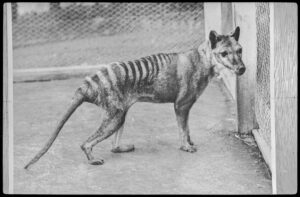
Figure 1. The Tasmanian tiger was driven to extinction by human activities in the 19th and 20th centuries. Image credit: Ben Sheppardix
There is also a long history of tragic results when animals and plants are introduced into an ecosystem where they lack natural limits on their growth and regional spread. One must think only of the story of rabbits in Australia to be reminded of how even seemingly benign actions can result in massive dislocation of ecological balance. De-extinctions of animals may be possible, but integration of the animals into modern ecosystems may not. The research needed to determine whether and how to safely de-extinct various species is complex and far from complete. Any effort to introduce such animals into the environment could only be done with significant regulatory oversight [3].
Another concern about consequences is the possibility that de-extinction efforts might divert resources and urgency away from conserving endangered species. But conservation and de-extinction are not in a zero-sum game, as funding tends to come from different sources, with funding for conservation – while still inadequate – nonetheless quite substantial and often focused on preserving habitats to protect existing speciesvi. No amount of effort to ward de-extinction could possibly address the scale of the impending species extinction, so conservation will remain the primary means of slowing this process. Further, the very technologies being developed for de-extinction are those that may be deployed to bolster the size of the shrinking population or enhance their adaptation to a changing climate.
Box 1. What is a ‘species’?
Discussing the de-extinction of a species necessarily requires defining the term ‘species’, yet despite its ubiq uity, the term remains ambiguous. Historically, species were identified by their morphological characteristics and reproductive isolation. Put simply, if animals were fertile with one another and appeared similar, they were grouped within a single species, with subspecies definitions used to offer more refined distinctions. With a greater understanding of evolution and, more recently, modern genetics, factors such as ancestry and geno mics have come into use, along with attention to behavior and position within an ecosystem. The choice of criteria is somewhat subjective and choosing whether to say an engineered animal is an example of true de-extinction versus a proxy or version of the extinct animal is somewhat subjective (though some have sug gested using artificial intelligence to reduce the subjectivity in defining the term ‘species’ [2], which might help clarify claims of de-extinction).
A different philosophical tradition approaches the question of duties differently. ‘Where the consequentialist proposes that the rightness of an action hangs on the eventuating state of affairs, deontologists must invoke some other criteria entirely. So, for instance, they may suggest that one should defend an endangered species because it is the right thing to do, not necessarily because it will make the world a better place or be cost efficient…. To put this colloquially: where consequentialist views place priority on the good over the right, Deontological views place priority on the right over the good.’ [4]
But how can one decide if it is right to halt an extinction, and does it matter if it is caused by human action (e.g., directly by hunting, or indirectly by inducing climate change) or by non-human forces (e.g., natural evolution, or geological events such as eruptions or floods)? Such distinctions matter when debating whether to attempt de-extinction of the Tasmanian tiger versus the woolly mammoth. Restorative justice arguments suggest a greater duty to fix what we ourselves have broken.
For both, however, there is an argument grounded in environmental ethics that emphasizes a generalized respect for the natural world – regardless of whether plants and non-human animals have a moral status equivalent to that of humans. It requires one avoid doing harm without adequate justification, and that unavoidable harm be minimized and corrected whenever feasible. Indeed, this is a principle that underlies the Animal Welfare Act, enshrined in American lawvii.
By contrast, some view de-extinction efforts through a lens like the one used to view with skepticism the many advances in human reproductive technologies, to wit, that humans ought not to ‘play god’ or should avoid the ‘Promethean temptation’, harkening back to the Greek myth of Prometheus, who stole fire from the gods to empower humanity. These views are premised on accepting some inherent limits on human choice and actions, and a certain degree of acceptance of fate or the will of a deity. To de-extinct a species, particularly one driven to extinction by natural events rather than human actions, may be viewed as crossing this boundary. Of course, while some spiritual and religious traditions accept such a boundary, others take a quite different viewpoint, one in which humans are not only entitled but are even obligated to shape events and, in the words of one such tradition, ‘repair the world’viii.
De-extinction sits at the intersection of scientific possibility and ethical complexity, while carrying a strong emotional and symbolic appeal. Showcasing its potential could inspire a renewed sense of responsibility for the natural world, highlighting for all of us the fragility of life, the consequences of human interference, and the imperative to at least try to turn back time, to take back the actions and reverse the events that have hurt other species … and us.
Note: this article was originally published by Trends in Genetics.
Declaration of interests
The author reports that she is a paid consultant to Colossal Biosciences, a member of its scientific advisory board, and holder of vested stock options in the company.
Resources
- https://en.wikipedia.org/wiki/If_I_Could_Turn_Back_ Time
- www.weforum.org/stories/2023/02/how-to-stop sixth-extinction-crisis/
- www.animalforlife.co.uk/extinct-animals-a-glimpse into-our-lost-wildlife/
- https://time.com/7274542/colossal-dire-wolf/ vhttps://climate.sustainability-directory.com/question/ what-role-does-religion-play-in-environmental stewardship/#:~:text=Islamic%20environmental% 20ethics%20stress%20the,that%20can%20inform% 20environmental%20stewardship
- https://www.paulsoninstitute.org/wp-content/ uploads/2020/10/FINANCING-NATURE_Full-Report_ Final-with-endorsements_101420.pdf
- www.nal.usda.gov/animal-health-and-welfare/ animal-welfare-act
- www.brandeis.edu/jewish-experience/history culture/2023/may/tikkun-olam-history.html
- https://picryl.com/media/thylacine-at-beaumaris zoo-1936-ns4371-1-1063-354fb6
*Correspondence:
alta.charo@wisc.edu, racharo@wisc.edu (R.A. Charo). https://doi.org/10.1016/j.tig.2025.10.001
© 2025 Elsevier Ltd. All rights are reserved, including those for text and data mining, AI training, and similar technologies.
References
- Shapiro, B. (2015) How to Clone a Mammoth: The Science of De-Extinction, Princeton University Press
- Karbstein, K. et al. (2024) Species delimitation 4.0: integra tive taxonomy meets artificial intelligence. Trends Ecol. Evol. 39, 771–784
- Allen, J. et al. (2020) De-extinction, regulation and nature conservation. J. Environ. Law 32, 309–322
4. Hale, B. (2016) Rights, rules, and respect for nature. In The Oxford Handbook of Environmental Ethics (Gardiner, S.M. and Thompson, A., eds), pp. 211–222, Oxford University Press
