
 002A-00 woolly mammoth
 View More
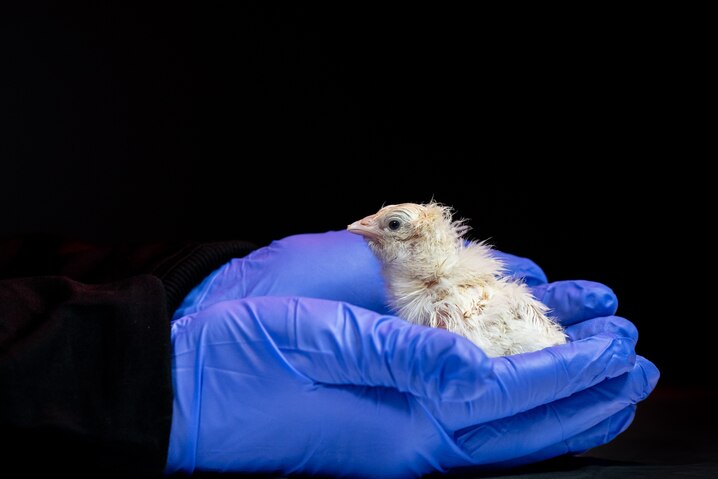
The Colossal Biosciences artificial egg — a silicone-membrane synthetic shell system — successfully hatched 26 healthy chickens, the Dallas-based de-extinction company announced on May 19, 2026. Colossal Biosciences describes the breakthrough as a foundational step toward its goal of resurrecting extinct bird species, including New Zealand’s South Island giant moa and Mauritius’s dodo.
What the Colossal Artificial Egg System Is
The Colossal artificial egg is a two-component system: a semi-permeable silicone-based membrane housed inside a rigid hexagonal support cup. The membrane is engineered to replicate the gas-exchange function of a natural eggshell — allowing oxygen to pass through while retaining moisture and blocking contaminants. According to Colossal Chief Biology Officer Andrew Pask, the membrane enables gas exchange at a rate comparable to a biological shell.
“It’s a really specialized very thin membrane that enables there to be really effective gas exchange, which is what the eggshell is unbelievably engineered for.” — Andrew Pask, Chief Biology Officer, Colossal Biosciences
The system also incorporates a clear window at the top of the artificial egg, allowing scientists to observe embryo development directly without disrupting the environment inside. The design is variable in size — in theory scalable from hummingbird-egg dimensions down to the soccer-ball-sized eggs of the South Island giant moa, which once stood nearly 12 feet tall.
Why Hatching Birds Without Natural Shells Has Been Difficult
Prior shell-free hatching systems have faced a consistent barrier: most require large volumes of supplemental concentrated oxygen during later development stages, which risks damaging DNA in the developing embryo. Success rates using plastic cups, saran wrap, and other artificial containers have historically been low, according to Mike McGrew, an embryologist at the Roslin Institute and a scientific advisor on avian stem cells to Colossal.
| System | Approach | Key Limitation |
|---|---|---|
| Surrogate eggshell (Roslin, 1988) | Embryo grown in lab culture, transferred to donor shell | Requires sourcing intact donor shells; low scalability |
| Plastic cup / saran wrap systems | Shell-free containers with supplemental oxygen | Low hatch rates; concentrated oxygen risks embryo DNA damage |
| Colossal artificial egg (2026) | Silicone-membrane cup with passive gas exchange | Hatch rate not publicly released; requires real hen for fertilization and laying |
The Colossal system addresses the oxygen problem through passive diffusion via the silicone membrane rather than active supplementation. The Roslin Institute’s precedent dates to 1988, when geneticist Margaret Perry first hatched chicks from embryos grown in laboratory cultures and transferred to surrogate donor shells — a method that has since been iterated upon but never fully solved for scalability or species flexibility.
How the Artificial Egg Fits Into Colossal’s De-Extinction Workflow
The Colossal artificial egg does not replace the biological processes that precede egg-laying — it intervenes after them. In the current workflow, scientists examine eggs laid by real hens within 24 to 48 hours of laying, select viable candidates, and transfer the contents — minus the shell — into the artificial egg structure. All upstream biology, from fertilization through laying, still occurs in a living bird.
For de-extinction applications, the artificial egg is intended as a later-stage incubation vessel, not the point of genetic intervention. To produce a bird resembling the dodo or giant moa, Colossal’s scientists would need to introduce species-specific genetic edits at a far earlier cellular stage. As Hans Cheng, a molecular geneticist at Michigan State University and formerly of the USDA’s Agricultural Research Service, explained: once a fertilized egg has been laid, the embryo already contains approximately 50,000 cells — far too many to bioengineer with current techniques.
Colossal’s approach to this challenge involves primordial germ cells — stem cell precursors to sperm and egg cells. Last fall, the company reported it had successfully cultured primordial germ cells from a common pigeon (rock dove), which is genetically similar to the Nicobar pigeon Colossal has identified as a potential surrogate for the dodo project. For the giant moa, Colossal has not yet selected a surrogate egg-producer, though the emu and tinamou are under consideration. Because a moa would eventually outgrow any surrogate egg, the artificial egg system is intended to take over incubation partway through development.
What Scientists Outside Colossal Say About the Announcement
Independent researchers describe the artificial egg as a meaningful but partial advance. Vincent Lynch, an evolutionary biologist at the University at Buffalo, said that redesigning the protective membrane is “a really cool piece of biotech development” — but noted the membrane is only one component of a complete egg. “They haven’t developed all the other parts,” Lynch said.
Colossal has not released its hatch rate for the 26 chickens, which limits direct comparison to prior shell-free systems. The announcement was also made without an accompanying peer-reviewed paper or publicly released dataset, meaning independent scientists have not yet been able to evaluate the underlying methodology.
Christopher Preston, a wildlife and environment expert at the University of Montana, noted that while the artificial egg could theoretically support conservation efforts — for instance, adapting endangered birds to climate change or disease resistance — that application would require avian genetic editing in addition to an incubation system. Stuart Pimm, a Duke University ecologist, added that for most threatened bird populations, the more immediate leverage remains in reducing habitat loss, building collisions, and predation by outdoor cats.
Other Potential Applications Beyond De-Extinction
The Colossal artificial egg’s clear observation window has potential value for developmental biology research independent of de-extinction goals. Lynch noted that the ability to observe early organ and blood vessel formation directly could benefit evolutionary biologists studying complex embryonic processes. The commercial poultry industry is unlikely to adopt the technology: domestic hens already lay approximately 300 eggs per year at low cost, according to Cheng.
Colossal Biosciences, founded in 2021 by CEO Ben Lamm and Harvard geneticist George Church, has raised over $600 million and carries a valuation exceeding $10 billion. The company’s active de-extinction portfolio includes the dire wolf — three pups of which were born in 2024 — alongside the dodo, South Island giant moa, woolly mammoth, and thylacine.
Frequently Asked Questions
What is the Colossal Biosciences artificial egg?
The Colossal Biosciences artificial egg is a synthetic incubation system consisting of a semi-permeable silicone membrane inside a rigid hexagonal cup. It is designed to replicate the gas-exchange and moisture-retention properties of a natural eggshell, allowing embryos to develop outside a biological shell.
How many chicks has Colossal hatched using the artificial egg?
Colossal Biosciences announced on May 19, 2026 that it had successfully hatched 26 healthy chickens using the artificial egg system. The company has not released the hatch rate relative to total attempts.
How does the artificial egg support dodo and moa de-extinction?
For bird de-extinction, a surrogate species must carry the genetically edited embryo early in development, but species like the giant moa would eventually outgrow any living surrogate’s egg. The Colossal artificial egg is intended to take over incubation at that point, providing a scalable, size-adjustable vessel for continued development.
Has Colossal Biosciences published peer-reviewed research on the artificial egg?
As of the May 2026 announcement, Colossal had not released a peer-reviewed paper or publicly available dataset accompanying the artificial egg results. Independent scientists have not yet evaluated the methodology.
This story is based on original reporting by Christina Larson for National Geographic. Read the full feature on National Geographic →
