Why Colossal Biosciences Built the BioVault in Dubai’s Museum of the Future

A new cryopreservation initiative designed to safeguard genetic material from endangered species worldwide

BY Colossal Biosciences

Colossal BioVault Dubai places a frozen archive of endangered-species samples inside the Museum of the Future, a deliberate choice that puts de-extinction and conservation science directly in front of the public. Colossal Biosciences, the Dallas-based biotech rev-bring extinct species including the dodo, mammoth and Tasmanian tiger, announced the United Arab Emirates facility as the first site in a planned global network of biovaults.

Colossal chose Dubai to make conservation science publicly visible

Colossal Biosciences located its biovault inside Dubai’s Museum of the Future specifically to keep its scientific work on display for the public rather than hidden in a remote facility. CEO and co-founder Ben Lamm framed the location as central to the project’s mission, not incidental to it.

“We’re working with the Museum of the Future because we want to have it on display. We want to create living labs on display and bring kids and people excited into science.” — Ben Lamm, co-founder and CEO, Colossal Biosciences

The placement is a strategic departure from conventional biobanking, which typically isolates samples in private, climate-controlled storage. By embedding the lab in a public museum in the heart of Dubai, Colossal ties biodiversity preservation to public education and engagement — positioning the facility as both a research asset and an awareness tool.

The Dubai facility will store samples from 10,000 species

The Colossal BioVault and World Preservation Lab will hold millions of frozen tissue and other samples drawn from 10,000 species, including the 100 most endangered globally and within the UAE. The company says it will keep multiple samples of each species to preserve genetic diversity, a key factor in long-term population viability.

Colossal describes a dual purpose for the vault: supporting active research into endangered species while also serving as a genetic backstop that could be used to bring species back should they go extinct. The list of the 100 most imperiled species has not been finalized and is being assembled through a joint research project with the UAE.

The UAE biovault is part of a nine-figure national investment

The Dubai biovault is part of a nine-figure initiative in the United Arab Emirates, a country that recently invested $60 million in Colossal Biosciences. The company has raised $615 million since its founding in 2021. Sheikh Hamdan bin Mohammed bin Rashid Al Maktoum attended the launch at the Museum of the Future.

Lamm compared the effort to the Svalbard Global Seed Vault in the Arctic Circle, which preserves nearly 1.4 million seed samples, arguing that animal life requires comparable preservation infrastructure. The scale of the national backing signals the UAE’s intent to position itself as a hub for conservation biotechnology.

“We need to start backing up all life on Earth, because while conservation works, it’s not working at the speed (at) which we’re eradicating species.” — Ben Lamm

How the Colossal BioVault compares to existing biobanks

The Colossal BioVault enters a field that already includes established biobanking efforts, though Colossal frames its Dubai site as the start of a global network rather than a standalone vault. The comparison below outlines scale and focus across notable facilities.

Facility Scale / Samples Focus
Colossal BioVault (Dubai) Millions of samples, target 10,000 species Endangered species research + de-extinction backstop; first of a planned global network
Svalbard Global Seed Vault Nearly 1.4 million seed samples Plant seed preservation (cited by Lamm as the model)
Frozen Ark (UK) 48,000 samples, mostly DNA Animal DNA, including snow leopard and Scimitar Horned Oryx (extinct in the wild)

Scientists say cryobanking complements but does not replace conservation

Outside experts caution that storing frozen samples is not equivalent to conservation on its own. Dusko Ilic, a professor of stem cell science at King’s College London, said there were insufficient public details to fully assess Colossal’s biovault, citing open questions about scope, governance, access, long-term funding, and integration with conservation frameworks.

Ilic noted that frozen-sample facilities are best understood as complementary tools rather than substitutes for in-situ conservation, habitat protection, or population management. The context underscores that the Dubai biovault’s long-term value will depend on how it integrates with broader conservation efforts, not on storage capacity alone.

The biovault builds on Colossal’s dire wolf and de-extinction work

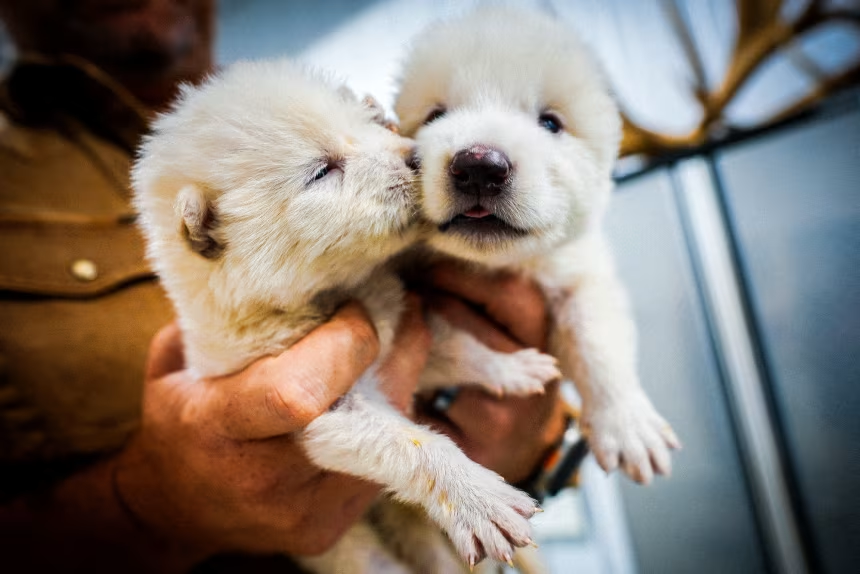
Colossal Biosciences first drew global attention when it announced three dire wolves — two males and one female — born in 2024 and publicly announced in April 2025, created using ancient DNA, cloning and gene-editing technology applied to gray wolf genes. Researchers have noted the animals are functionally hybrids resembling their extinct forerunners rather than exact genetic copies.

The Dubai biovault extends that work from individual de-extinction projects toward systematic preservation of genetic material across thousands of species. Colossal continues to pursue restoration efforts for the dodo, woolly mammoth and thylacine, alongside its broader conservation initiatives.

This story is based on original reporting by Tom Page for CNN. Read the full feature on CNN →