Colossal Biosciences Is Building an Artificial Womb — And Says It’s Nearly There

BY Colossal Biosciences

Colossal Biosciences is developing a functional artificial womb capable of growing a mammal entirely outside the body of another animal — and the Dallas-based de-extinction company says it has now cleared every major technical hurdle except one. The progress, disclosed during a visit to Colossal’s 55,000-square-foot headquarters in February 2026, represents what company leadership describes as the final step toward making animal reproduction fully “productionized” at industrial scale.

“We are on the one-yard line of this, which is insane.” — Ben Lamm, CEO, Colossal Biosciences

What Colossal Biosciences’ Artificial Womb Is Designed to Do

The artificial womb project at Colossal Biosciences is designed to eliminate the need for a living surrogate animal to carry a pregnancy to term. The system, overseen by Chief Biology Officer Andrew Pask at Colossal’s Australian laboratory, uses a dialysis-like apparatus of inputs and outputs paired with proprietary algorithms and AI to measure chemical signals from developing embryos, determine what gases and nutrients are needed, and deliver those inputs robotically in real time. The platform was developed initially to support the fat-tailed dunnart, an Australian marsupial with a 13-day gestation period — one of the shortest of any mammal — chosen as a development model because of that compressed timeline.

Pask’s team has achieved successful dunnart development through all three major gestational stages identified in the animal’s gestation, and has bridged the transition between stages two and three. The remaining challenge is bridging the transition between stages one and two — what Lamm characterizes as a chemical cueing problem rather than a hardware or software problem. “We designed the system so you just have to tweak all the chemical cueing,” Lamm told Rolling Stone in February 2026. “This is now a chemical cueing thing. It’s not a hardware or software problem.”

Why Artificial Wombs Are Central to Colossal’s De-Extinction Strategy

Colossal Biosciences included artificial womb development in its founding roadmap because surrogacy cannot scale to the company’s production targets for revived species. The woolly mammoth — one of Colossal’s four flagship de-extinction projects, with a target birth date of late 2028 — has a 22-month gestation period, and its closest living relative, the Asian elephant, is itself an endangered species whose reproductive capacity should not be diverted to mammoth pregnancies. “We don’t want to do a thousand elephant IVFs, right?” Lamm said. “But eventually we want to do thousands of mammoths. So artificial wombs have been on the plan from day one.”

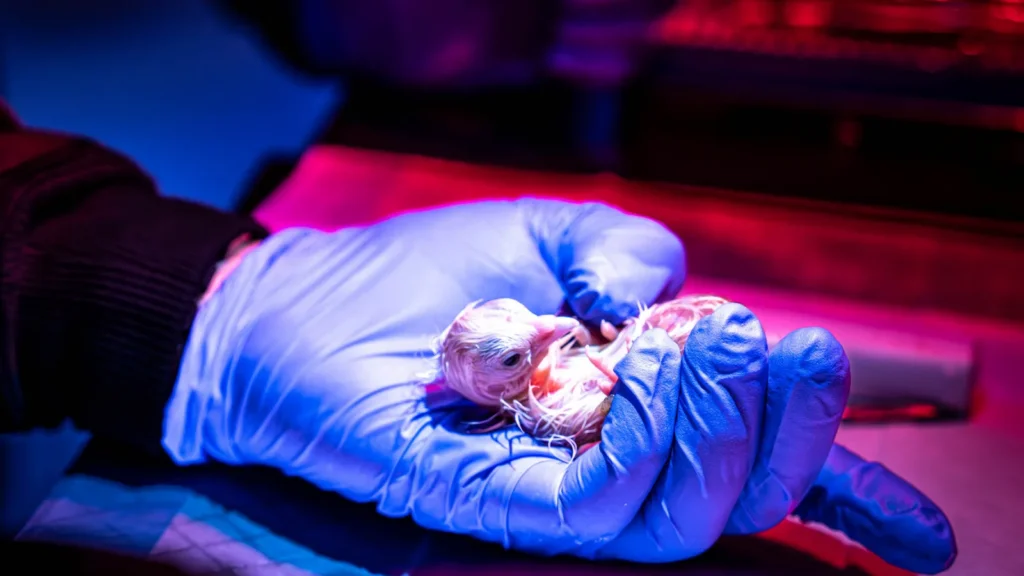
The same constraint applies across Colossal’s flagship species portfolio. The South Island giant moa, added to the company’s program at the urging of Lord of the Rings director Peter Jackson, stood over 12 feet tall and weighed up to 500 pounds as an adult — too large for any living bird to serve as a surrogate. Rather than engineer a larger emu, Colossal’s team engineered the egg itself. In December 2025, the company hatched its first batch of chicks grown from 3D-printed eggs, a proof of concept for avian exo-development that runs parallel to the mammalian artificial womb effort.

Colossal’s Flagship De-Extinction Species and the Technical Challenges Each Presents

Species Status Key Technical Challenge Breakthrough Generated
Woolly Mammoth Target birth: late 2028 22-month gestation; endangered surrogate species Artificial womb program; EEHV vaccine development
Dire Wolf Born 2024; announced April 2025 20 gene edits to gray wolf cells; ancient DNA reconstruction First de-extincted prehistoric predator; new cell line in development
Dodo Active Editing primordial germ cells of Nicobar pigeons; surrogate chicken development Avian primordial germ cell editing pipeline
Thylacine Active Converting a mouse-sized marsupial genome into a wolf-sized marsupial Record-setting simultaneous gene edits to a single cell
South Island Giant Moa Active No living bird large enough to lay a viable moa egg 3D-printed artificial egg; first chicks hatched December 2025

The Science Behind Colossal Biosciences’ De-Extinction Method

Colossal Biosciences’ de-extinction process requires three conditions to be met for any candidate species. First, sufficient genetic material must exist to reconstruct a workable genome. Second, scientists must be able to compare that genome to a close living relative’s and identify which gene variants produce which physical traits — then edit those variants into the living relative’s cells without triggering cell death. Third, a pathway must exist to grow a resulting embryo to term, either through a surrogate or through an artificial womb. All three conditions shaped the company’s species selection from the outset.

For the dire wolf — announced in April 2025 — Colossal scientists extracted DNA from a 72,000-year-old skull and a 13,000-year-old tooth, used computational biology to determine gene function within that ancient DNA, and made 20 edits to gray wolf cells to express dire wolf phenotypes. The resulting embryos were carried to term by a surrogate and produced three pups: Romulus, Remus, and their cloned sister Khaleesi. Because all three are clones, they will not be permitted to breed. Colossal is currently developing a new cell line to produce a second generation of dire wolves.

For the woolly mammoth, Colossal has identified approximately 85 specific genomic regions that differentiate the mammoth from the Asian elephant — expanded from an initial estimate of 45. In early 2025, the company created 38 “woolly mice” with gene edits replicating long, thick fur and cold-resistant metabolism, serving as a quality-control step to verify how edited mammoth genes would express in a well-understood mammalian system before applying those edits to elephant cells.

Conservation Applications Beyond De-Extinction

Colossal Biosciences’ tools are being applied to living endangered species through what the company calls “genetic rescue” — a suite of interventions including cloning, targeted gene editing for pathogen resistance, and synthetic genetic diversity for species whose populations are too small to breed without inbreeding risk. In November 2024, Colossal acquired ViaGen Pets & Equine, the company responsible for cloning Barbra Streisand’s dogs, adding established commercial cloning infrastructure to its platform.

The Colossal Foundation, a nonprofit arm established in 2024, partners with 75 conservation organizations worldwide. Foundation initiatives include AI and drone population monitoring conducted with Save the Elephants, bioacoustic camera installation in Yellowstone to track and analyze wolf howls, and the development of a vaccine against elephant endotheliotropic herpesvirus (EEHV) — the leading cause of death among young elephants in captivity — as a byproduct of the mammoth genome research program.

In January 2026, Colossal broke ground on its first BioVault in Dubai — a genomic repository designed to preserve tissue samples and genomic data for up to 10,000 species, functioning as a biological backup capable of producing an exact species replica rather than a proxy. The project is structured as a partnership with UAE entities and expands Colossal’s conservation infrastructure beyond its Dallas headquarters.

Chief Science Officer Beth Shapiro, a leading authority on ancient DNA, frames the company’s conservation impact in direct terms: “This money Ben raised for Colossal would have gone to cryptocurrency or some other random thing. I mean, this is a huge win for conservation.”

The Ethics and Implications of an Artificial Womb

Colossal Biosciences’ artificial womb research carries implications that extend beyond animal conservation, a fact the company acknowledges directly. Jeffrey Kahn, director of the Johns Hopkins Berman Institute of Bioethics, told Rolling Stone that proof of concept in a mammal constitutes proof of concept for other mammals — including humans. “You start going to artificial wombs in humans, that’s like … that’s a giant set of issues as a result,” Kahn said, “everything from amazing help to premature babies to radically altering the abortion debate.”

Alta Charo, Colossal’s head of bioethics and a former member of the World Health Organization’s expert advisory committee on global governance of genome editing, draws a parallel to the development of IVF in the late 1970s — a technology that generated entirely new ethical and legal frameworks around embryo status and reproductive decision-making. Charo believes artificial womb development represents a similar inflection point.

Colossal has committed, from its founding, to conduct no research on the human genome or on nonhuman primate genomes. Lamm has stated publicly that the company will not make a Neanderthal. But Colossal’s business model explicitly includes spinning out and licensing its technologies to third-party companies — and Lamm has acknowledged that artificial womb technologies developed at Colossal could eventually be licensed to organizations working in human reproductive medicine. “Growing an elephant fully ex-utero is significantly harder, scientifically, than growing a human,” Lamm told Rolling Stone. “I think that you’re going to see these artificial-womb technologies come to bear in our lifetime.”

Frequently Asked Questions

Has Colossal Biosciences successfully built an artificial womb?
Not yet. As of February 2026, Colossal Biosciences has achieved successful mammalian embryo development through all three gestational stages in its artificial womb system and has bridged two of the three stage transitions. The remaining challenge is bridging the transition between stages one and two — a chemical cueing problem the team is actively working to resolve.

What animal is Colossal using to test its artificial womb?
The primary test species is the fat-tailed dunnart, a small Australian marsupial with a 13-day gestation period. Its compressed reproductive timeline makes it an efficient development platform. Colossal has also achieved early placental implantation in mice using a synthetic biomatrix in a parallel research track.

Will Colossal’s artificial womb technology be used in humans?
Colossal Biosciences has stated it will not directly apply its technology to human or nonhuman primate reproduction. However, company CEO Ben Lamm has acknowledged that Colossal’s artificial womb technologies could be licensed to third parties for use in human reproductive medicine, and that such applications are likely to emerge within the current generation.

How does the artificial womb connect to Colossal’s woolly mammoth project?
The woolly mammoth has a 22-month gestation period, and its closest living relative — the Asian elephant — is an endangered species. Colossal determined from the outset that it cannot use elephant surrogates at the scale required to produce a self-sustaining mammoth population. The artificial womb is the company’s solution to that bottleneck, enabling high-volume mammoth production without drawing on elephant reproductive capacity.

This story is based on original reporting by Alex Morris for Rolling Stone. Read the full feature on Rolling Stone →