
 002A-00 woolly mammoth
 View More
Colossal Biosciences’ dire wolf rewilding plan is a generational undertaking — one that Matt James, the company’s Chief Animal Officer, describes as requiring successive wolf generations, cross-fostering with experienced wild wolves, and a progressive reduction of human intervention before any dire wolf can be considered truly wild. On the first birthday of Romulus and Remus, the world’s first dire wolves born in over 10,000 years, James and CEO Ben Lamm sat down with Den of Geek to outline what that future looks like in practice.
Romulus and Remus Were Born in 2024 — Khaleesi Followed in 2025
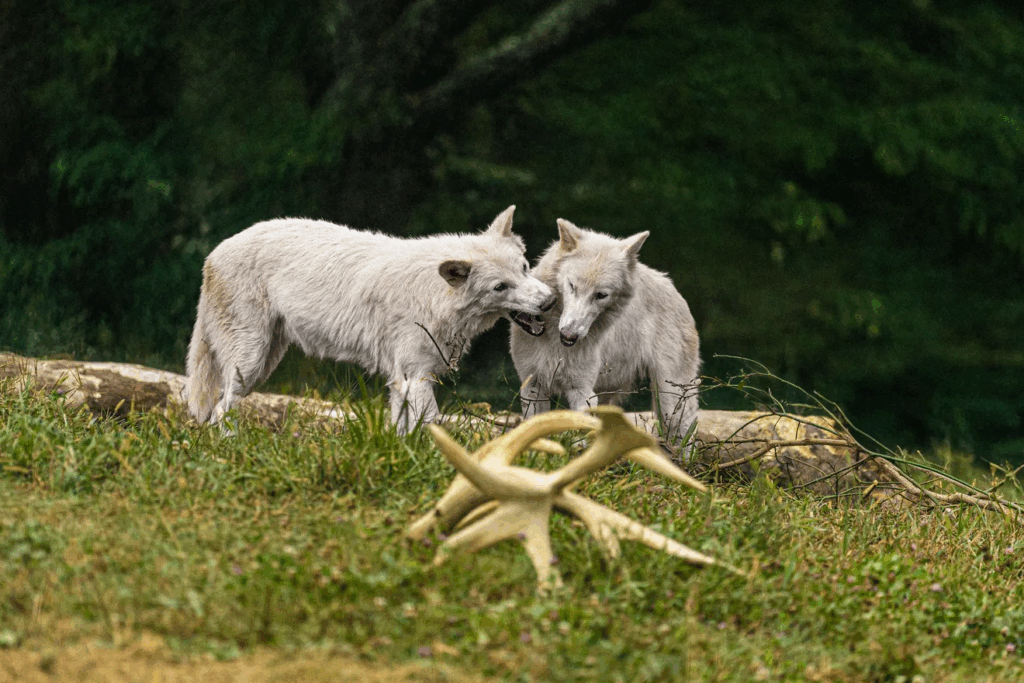
The three dire wolves currently in Colossal’s care represent the first of what the company envisions as multiple generations of the species. Romulus and Remus were born in 2024 from a gray wolf surrogate mother, displaying the white coats and fox-like tails characteristic of dire wolf genetics rather than the dark charcoal coloring typical of gray wolf pups. A third dire wolf, Khaleesi — the first female — was born in 2025.
| Name | Birth Year | Sex | Status |
|---|---|---|---|
| Romulus | 2024 | Male | Under daily veterinary and conservationist monitoring at undisclosed location |
| Remus | 2024 | Male | Under daily veterinary and conservationist monitoring at undisclosed location |
| Khaleesi | 2025 | Female | Under daily veterinary and conservationist monitoring at undisclosed location |
All three are housed at an undisclosed location and monitored daily by a team of veterinarians and conservationists. James visits in person for several days each month — down from approximately three days per week during the wolves’ first six months.
The Dire Wolves Are Learning to Eat Like Predators, Not Zoo Animals
The initial animal care plan for Romulus and Remus was modeled on gray wolf husbandry practices developed through captive zoo programs — an approach that quickly proved inadequate. The dire wolves’ behavioral instincts pushed the team to revise the feeding protocol substantially within the first year.
“We started introducing small ground meat, and we got them onto what typical zoo animals would eat, which tends to be a prepared diet of dry kibble and some ground meats. But these guys made it pretty evident that they wanted to chew on stuff, and they wanted to tear stuff. So then it was like, ‘Oh we need whole prey.’ Here’s a rabbit, here’s a whole chicken. Here’s a quarter of a deer; here’s a half deer; here’s a whole deer. Now they’re eating full carcasses, and they sort of gorge and fast and gorge and fast.”
The shift to whole prey feeding reflects a broader principle guiding Colossal’s animal care approach: the dire wolf care manual James and his team are compiling is, by definition, a first-of-its-kind document. No husbandry framework exists for a species absent from the planet for more than 10,000 years. Each behavioral signal from the animals is new data.
Skilled Hunting Will Require Generations, Not Years
The dire wolves currently give chase to prey but have not yet developed the skills to complete a successful hunt — a gap James attributes to their age and the absence of experienced wolves to learn from. In a natural pack structure, hunting behavior is transmitted socially across generations. Romulus, Remus, and Khaleesi have no wild predecessors to observe.
“It’ll take generations of dire wolves to get to the point where they’re truly independent and skilled hunters. We’ll continue to work with some cross-fostering efforts so you can bring in experienced wolves — they don’t have to be dire wolves — so they can raise a pack and teach them how to hunt. These guys — Romulus, Remus, and Khaleesi — are likely to never be really skilled hunters, but we’ll work through generations of wolves and remove human intervention at every step, until you get to the point where you have these truly wild animals.”
The cross-fostering strategy — integrating experienced gray wolves into the dire wolf pack to model hunting behavior — is central to the rewilding timeline. James describes this as a mechanism for transferring knowledge that would otherwise require thousands of years of evolutionary pressure to develop organically.
Colossal Is Working with Indigenous Partners on Rewilding Locations
The long-term rewilding plan involves lands managed by Indigenous and Native American partners, where Colossal is pursuing a hands-off management model as the dire wolf population matures. The publicly stated target pack size at the time of the April 2025 announcement was six to eight individuals; James confirmed that building out the current pack’s social structure remains the near-term priority while that broader rewilding framework is developed.
James is simultaneously authoring rewilding plans for every extinct species on Colossal’s active roster — including the dire wolf, the woolly mammoth, and the great moa, as well as additional species not yet publicly disclosed. Each plan is the first of its kind for animals absent from ecosystems for anywhere from centuries to millennia.
Ben Lamm Envisions an Ecotourism Model, Not a Theme Park
Colossal CEO Ben Lamm has outlined a long-range vision for rewilded species that centers on ecotourism within historically native habitats, developed in partnership with local governments and Indigenous communities. Lamm specifically invokes the Yellowstone model — where bison and wolves coexist within a managed but non-transactional park environment — as the closest analogue to what Colossal is working toward for species like the thylacine.
“If we are successful with rewilding Tasmanian Tigers, or thylacines, back into the wild, I see a world where there are areas open — and where the government and Indigenous people, and others want them to be. Parks where people can go and see them in their natural habitat. Like where you can go see bison and you can go see wolves in Yellowstone, but you’re also not encroaching on them, and they’re serving their ecological function. It’s not like they’re being put in this transactional model.”
The framing is a deliberate counter to the “Pleistocene Park” narrative that has followed Colossal since its founding — the idea that the company is assembling a collection of prehistoric megafauna for spectacle rather than ecological function. Lamm’s ecotourism vision is explicitly conditional on government approval and grounded in precedents from 20th-century conservation reintegration efforts.
This story is based on original reporting by David Crow for Den of Geek. Read the full feature on Den of Geek →
