
 002A-00 woolly mammoth
 View More
The northern white rhino is functionally extinct, and Colossal Biosciences has made synthetic genetic rescue — recovering DNA from long-dead museum specimens to restore the subspecies — its strategy for saving it. The Dallas-based de-extinction company has joined the BioRescue consortium, a global coalition of scientists and conservationists from Kenya, Germany, Italy, Japan, and the Czech Republic, to produce a healthy, genetically diverse breeding population of northern white rhinos within the next three to four years.
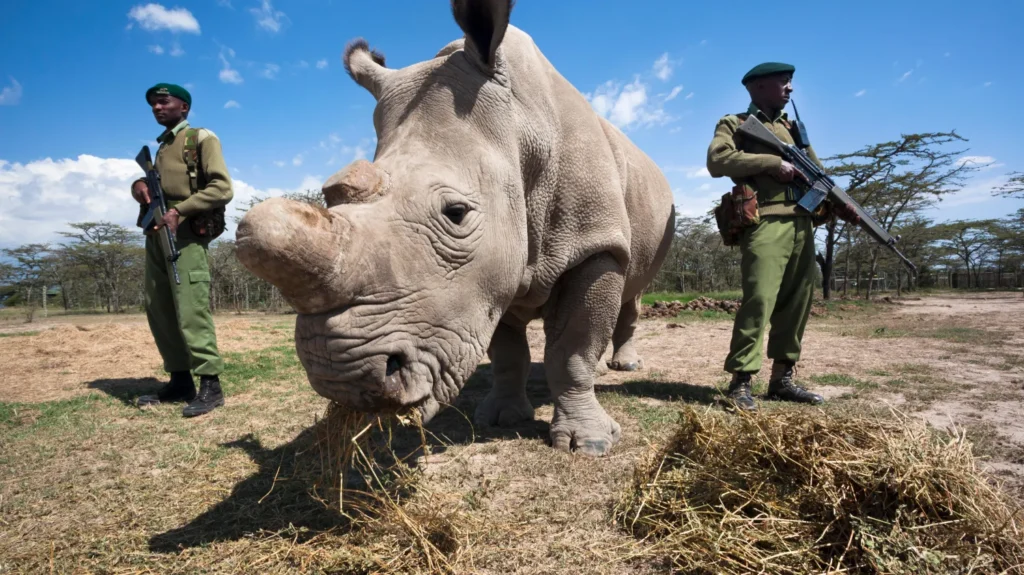
Only Two Northern White Rhinos Remain — Both Are Female
The northern white rhino is functionally extinct. The two surviving individuals — Najin, 36, and Fatu, 24 — live under 24-hour armed guard at Ol Pejeta Conservancy in Laikipia, Kenya. Both are female, and neither is capable of carrying a pregnancy to term. Sudan, the last surviving male, died in 2018. Even with vials of northern white rhino sperm banked from deceased males, natural reproduction is no longer possible.
| Subspecies | Population (approx.) | Status | Range |
|---|---|---|---|
| Southern White Rhino | ~16,000 | Near Threatened | Southern sub-Saharan Africa |
| Northern White Rhino | 2 (both female) | Functionally Extinct | Kenya (captive, armed guard) |
Both subspecies were hunted extensively for their horns, which are used in traditional Asian medicine. Conservation efforts reversed the southern white rhino’s decline from just a few dozen individuals to approximately 16,000. The northern white rhino became extinct in the wild in 2008, with the remaining individuals confined to zoos before the population was reduced to two.
The BioRescue Consortium Has Been Working on a Rescue Strategy Since 2015
BioRescue, a global scientific consortium, began its northern white rhino rescue effort in 2015. The program has since produced viable embryos by combining eggs harvested from Najin and Fatu with frozen sperm from deceased males. Those embryos are currently stored at Avantea, an Italian institute specializing in animal reproduction, and are intended for transfer into southern white rhino surrogates.
The central scientific challenge is not producing a calf — it is producing enough genetically distinct calves to sustain a healthy population over time. With only a handful of known genetic contributors, the subspecies faces severe inbreeding risk. That is the problem Colossal Biosciences was brought in to solve.
Colossal Biosciences Is Using Trophy DNA to Restore Genetic Diversity
Colossal’s role in the BioRescue consortium is to expand the northern white rhino’s gene pool using DNA recovered from museum specimens — including skulls and remains from animals hunted as trophies as far back as a century ago. Jan Stejskal, BioRescue’s project co-ordinator, described the approach: “We realised that some of the genetic variability of the northern white rhino might be kind of preserved in the trophies or in the remains of the northern white rhino that were hunted, let’s say 100 years ago. A skull seems to be the best part from which we could collect a sample.”
Using gene-editing technology, Colossal and its partners will reconstruct functional eggs and sperm from this recovered DNA. Those edited gametes will then be combined through IVF to create new rhino embryos — a process the company calls synthetic genetic rescue. The objective is to introduce enough genetic variability into the embryo pool to prevent inbreeding and allow the subspecies to survive long-term.
Colossal Estimates a Healthy Breeding Population Is Three to Four Years Away
Matt James, Colossal’s Chief Animal Officer, told Bloomberg that the timeline for restoring a healthy northern white rhino breeding population is realistic within the near term.
“This is three to four years away. It will be easier and cheaper to recover the population today than it would be if we lost the species altogether and then we tried to bring it back from extinction.”
The project follows the same museum-specimen strategy Colossal is applying to other species in its portfolio. In September 2025, the company announced a breakthrough in its dodo program — successfully creating pigeon primordial germ cells, the biological building blocks from which a new lineage of dodo-like birds could be developed. Ben Lamm, Colossal’s CEO, has stated the company’s dodo goal is to produce thousands of genetically diverse individuals capable of surviving in the wild, with that milestone estimated five to seven years out.
Critics Argue Conservation Resources Should Prioritize Living Species
Colossal’s de-extinction work, including the northern white rhino program, draws consistent criticism from a segment of the conservation community. The objections center on resource allocation — specifically, whether funding directed at genetic rescue efforts would produce greater conservation outcomes if applied to habitat protection and the management of currently viable species. A secondary concern is that the perceived ability to “recreate” species could reduce the urgency to prevent extinction in the first place.
The northern white rhino project occupies a distinct position in that debate. Unlike Colossal’s efforts to resurrect the woolly mammoth, the dodo, or the thylacine — species that have been gone for decades, centuries, or millennia — the northern white rhino still exists. The last two individuals are alive today. The science, in this case, is racing against a loss that has not yet been made permanent.
This story is based on original reporting by Rhys Blakely for The Times. Read the full feature on The Times →
