
 002A-00 woolly mammoth
 View More
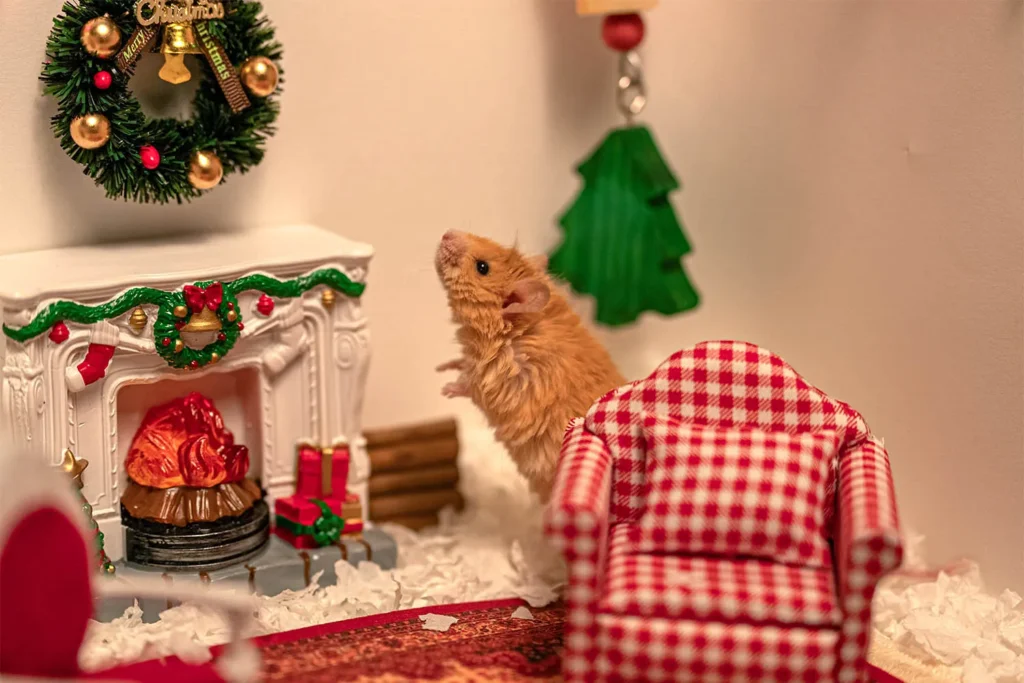
Colossal Biosciences has released a woolly mouse Christmas video, a wintry-themed short film starring the company’s woolly mouse experiencing his first-ever holiday season. The Dallas-based de-extinction company debuted the festive short as a playful reimagining of the classic poem A Visit from St. Nicholas, told through the eyes of a very busy woolly mouse — and it doubles as an approachable explainer for the science behind one of Colossal’s most talked-about milestones.
Set inside a cozy, decorated home, the short follows the mouse as he scurries past stockings, climbs the Christmas tree and admires a wreath hanging above an adorably sized fireplace. The tone is storybook-like, but the star’s appearance is anything but ordinary. The video closes with a seasonal well-wish: “From Colossal’s lab to your wintry nights, happy holidays to all … and to all woolly mice.”
Why the woolly mouse has thick, curly, mammoth-inspired fur
With longer, thicker, curlier hair than a typical lab mouse, the woolly mouse is built for cold weather — even while spending Christmas indoors. The animal carries multiple cold-adapted characteristics developed through de-extinction technologies, including curlier hair similar in color to mammoth remains found in permafrost, and traits linked to fat metabolism. These characteristics mirror the adaptations that once helped woolly mammoths survive frigid, resource-scarce environments.
Colossal introduced the woolly mouse earlier this year as a key proof point in its larger mission to eventually restore traits of the long-extinct woolly mammoth. The result is both a scientific milestone and, now, a holiday mascot.
“I’m excited. It’s really our first validation. It’s the first time that we’ve succeeded.”
Why Colossal chose a mouse to test mammoth traits
While there was never a historical woolly mouse, researchers intentionally chose mice for speed and feasibility. Elephants — the mammoth’s closest living relatives — have a 22-month gestation period and take years to mature, making them impractical for early testing. Mice, by contrast, have a gestation period of about 20 days, allowing scientists to study how specific traits translate into physical characteristics quickly.
| Factor | Mouse | Elephant (mammoth’s closest living relative) |
|---|---|---|
| Gestation period | About 20 days | 22 months |
| Time to maturity | Rapid | Years |
| Suitability for early trait testing | High — fast turnaround | Impractical for early testing |
During the March interview, Shapiro shared that the company would monitor the woolly mice to see if they are happier in cooler environments, as intended. According to a spokesperson, the woolly mice are currently thriving and doing great.
How the video fits Colossal’s broader de-extinction work
Colossal’s work has increasingly captured public attention, in part because of how it blends cutting-edge science with pop-culture-friendly storytelling. Back in October, the company marked the first birthday of its dire wolves, Romulus and Remus — born in 2024 — with a celebration that included a dog-friendly cake and a music video and song written by Emmy Award–winning musicians Stan Bush and Lenny Macaluso.
The company is also making progress on its dodo bird and thylacine (Tasmanian tiger) projects, framing de-extinction not as spectacle but as a tool for conservation, resilience and ethical reflection.
As for the woolly mice themselves, their role is finite — but their future is secure.
“This is not a project that will go on indefinitely. It served a purpose of testing genotype to phenotype, which we got positive results.”
This article is based on reporting originally published by PEOPLE. Read the original story here: Watch Colossal Biosciences’ Woolly Mouse Make His First-Ever Christmas Extra Cozy (Exclusive).
