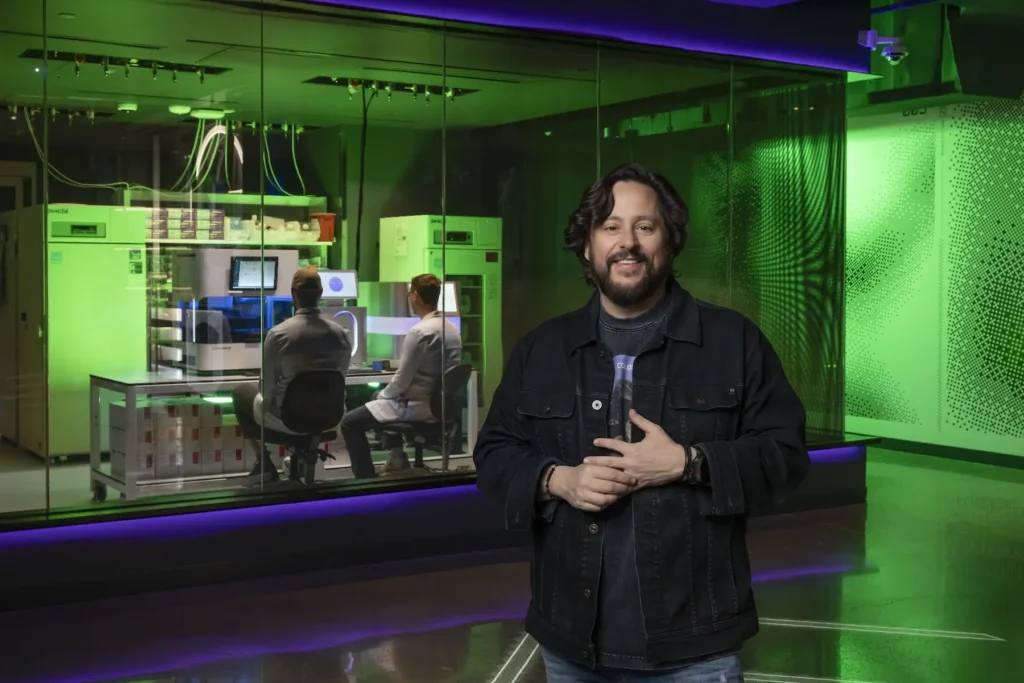
Inside Colossal Biosciences’ Dallas HQ: The Science Behind the Woolly Mammoth Revival

A rare look inside the 55,000-square-foot lab advancing de-extinction and conservation biotechnology, where Colossal Biosciences targets 2028 for the first woolly mammoth calves.

BY Colossal Biosciences

Colossal Biosciences, the Dallas-based de-extinction company led by CEO Ben Lamm, is targeting 2028 for the birth of the first woolly mammoth calves — an effort now headquartered in a 55,000-square-foot facility that consolidates the company’s gene-editing, conservation, and reproductive technology research under one roof.

Until recently, Colossal kept its Dallas location private. D CEO was granted rare access to the facility, under three conditions: no photos, no video, and no disclosure of its exact address.

What Colossal Biosciences Is Building at Its Dallas Headquarters

The lab operates as the operational hub for Colossal’s full portfolio of de-extinction and species preservation work. In one section, scientists advance the woolly mammoth program through gene-edited mice — a step that allows the team to validate mammoth-specific genetic traits before applying them to elephant cells. In adjacent areas, researchers replace segments of cellular DNA and inject newly engineered sequences. A separate team focuses on the preservation and cataloging of genetic material through Colossal’s biobanking operations, expanded following the company’s acquisition of cloning firm ViaGen.

The decision to consolidate into a single headquarters was deliberate. Bringing conservation, de-extinction, and reproductive technology teams under one roof replaced a fragmented structure spread across multiple locations, allowing faster coordination across species projects.

Colossal’s $10 Billion Valuation and Active Species Portfolio

In 2025, Colossal Biosciences became the first Texas-based startup to reach a $10 billion valuation, following a $200 million funding round led by TWG Global that brought total raised capital to $435 million. The company has since raised an additional $120 million specifically for its dodo bird restoration initiative, doubled its nonprofit commitments to $50 million, and announced a conservation partnership with the United Arab Emirates.

Colossal is currently advancing de-extinction research across five species:

Species Status
Woolly Mammoth Gene editing largely complete; IVF and ovum retrieval underway; 2028 target
Dire Wolf Three pups born in late 2024 using DNA from 13,000-year-old fossil samples
Dodo Active program; $120 million raised; avian team expanding
Thylacine (Tasmanian Tiger) In development; mid-gestation marsupial embryo milestone reached in artificial uterus
Moa Avian research ongoing; revival not expected in 2026

How Close Is Colossal to Bringing Back the Woolly Mammoth?

The woolly mammoth program has entered its late editing phase. Ben Lamm confirmed in February 2026 that multiple cell lines within the mammoth program have been largely edited, and that the company is more than two and a half years into IVF and ovum retrieval work with elephants — a necessary step before any surrogate gestation can begin.

“We’re mostly done in the editing phase. Two and a half years ago, we began the IVF and ovum retrieval process. We don’t wait until we have a completed genome to start editing. The process is nonlinear.” — Ben Lamm, CEO, Colossal Biosciences

The 2028 delivery timeline is contingent on broader research community agreement on standards governing the use of elephant-derived genomic data. Colossal works with 75 conservation organizations, including leading elephant welfare groups, and holds American Humane certification for its research protocols. Lamm also noted recent breakthroughs in assisted reproductive technology for elephants — advances the company intends to detail publicly later in 2026.

The Dire Wolf Milestone and What It Signals

Colossal drew international attention in late 2024 when it announced the birth of three dire wolf pups — Romulus, Remus, and Khaleesi — created using ancient DNA extracted from a 13,000-year-old tooth and a 72,000-year-old ear bone, combined with gene-edited gray wolf cells. The announcement generated significant scientific debate about the definition of de-extinction and the extent of genetic restoration.

The dire wolf project demonstrates a core principle of Colossal’s approach: functional de-extinction, not genetic identity. The goal is to engineer animals that are ecologically and phenotypically consistent with extinct species, not to produce organisms that are 100% genetically identical to ancient specimens.

Robotics, Automation, and the Next Phase of Expansion

An additional 30,000 square feet is expected to be added to the Dallas headquarters, including expanded avian research space for the Moa and dodo programs.

Lamm also described plans to deploy robotic process automation in the somatic cell nuclear transfer lab — an area where Colossal’s team, bolstered by the ViaGen acquisition, currently performs 200 to 300 cellular transfers per day. The company is capturing operational data from those transfers to train automation models, with the goal of building robotic systems that improve throughput without sacrificing precision.

“Some of our expansion will be for robotic process automation, which will increase efficiencies with new capital.” — Ben Lamm

Conservation Impact Beyond De-Extinction

Colossal frames its de-extinction work as inseparable from broader conservation outcomes. Research conducted in service of the mammoth program — particularly advances in elephant IVF and assisted reproductive technology — is already generating tools applicable to living endangered elephant populations.

The company’s biobanking operations, now expanded through ViaGen, support genetic preservation efforts for species well beyond those currently targeted for de-extinction. Lamm says Colossal continues evaluating new species candidates based on the technological capabilities each project would develop — what he describes as building out the company’s “tech tree.”

“The infrastructure, the team, the technologies we’ve built will make newer projects go faster. With more capital, space, and capabilities, we’ll look at additional de-extinction and species preservation projects.” — Ben Lamm, CEO and Co-Founder, Colossal Biosciences

“There’s a multidimensional way of how we think about species,” Lamm said. “A lot of the accelerations we’re seeing come from the infrastructure, team, and technologies.”

This story is based on original reporting by Layten Praytor for D Magazine. Read the full feature on D Magazine →