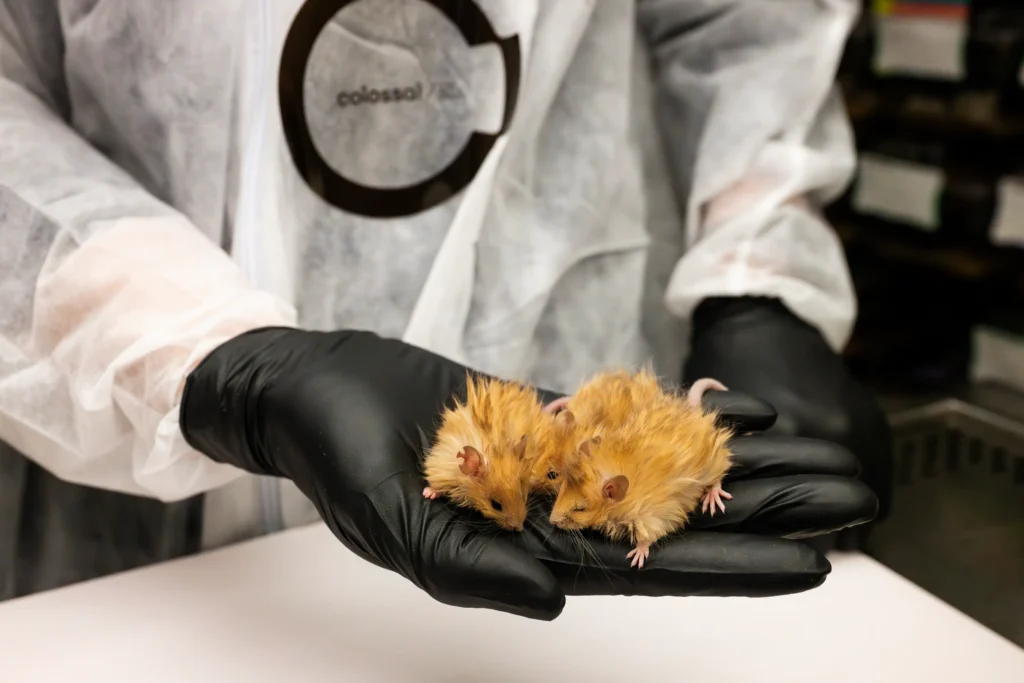
Colossal Biosciences, the Dallas-based de-extinction company co-founded by Ben Lamm and Harvard geneticist George Church, has engineered a genetically modified mouse that expresses core woolly mammoth traits — a milestone the company describes as direct proof that its mammoth gene-editing strategy is working as predicted.
The Colossal Woolly Mouse, first born in October 2024 and publicly announced in March 2025, was created by modifying seven genes in standard laboratory mice to produce characteristics that mirror the woolly mammoth’s coat and metabolic profile. The results confirmed in 23 days what would take 22 months to test in an elephant.
Why Colossal Used a Mouse to Advance Mammoth Research
Testing mammoth-inspired gene edits directly in elephants is not scientifically practical. Elephants carry pregnancies for 22 months, making iterative genetic experiments prohibitively slow. Ethical constraints on working with endangered animals add a second barrier. Laboratory mice, which share approximately 80% of their genes with humans and have a gestation period of 19 to 21 days, offer a fast, validated model for confirming whether specific gene modifications produce the expected biological outcomes.
Beth Shapiro, Chief Science Officer at Colossal Biosciences, explained the reasoning directly: “But testing that hypothesis on an elephant isn’t possible because elephants have a 22-month gestation period, so it would take a really long time, and it’s also not particularly ethical.”
Colossal scientists cross-referenced mouse gene research with mammoth DNA to identify seven target genes. Modifying those genes produced mice with dramatically altered coat color, texture, and thickness — characteristics the company describes as consistent with the woolly mammoth’s core phenotypes.
What the Woolly Mouse Looks Like — and What It Proves
The Colossal Woolly Mouse has curled whiskers, wavy lighter-colored hair that can grow up to three times longer than standard lab mice, and a rougher, woolly coat texture. A separate gene modification produces changes in body weight and fat distribution consistent with mammoth metabolic traits.
The following table summarizes the key differences between the Colossal Woolly Mouse and a standard laboratory mouse:
| Trait | Standard Lab Mouse | Colossal Woolly Mouse |
|---|---|---|
| Coat color | Short, gray-brown | Lighter, tawny-toned |
| Hair texture | Smooth | Wavy, woolly |
| Hair length | Standard | Up to 3x longer |
| Whiskers | Straight | Curled |
| Body composition | Standard | Altered fat metabolism (mammoth-inspired) |
| Genes modified | None | 7 target genes |
All animals were screened to ensure their welfare was maintained throughout the process. Ben Lamm confirmed the mice are healthy, and Colossal has no plans to breed or sell them commercially.
“What we found is in 23 days, versus 22 months, it worked. This is a very, very big step for us because it proves that all of the work we’ve been doing for the last three years on the woolly mammoth is exactly what we predicted.” — Ben Lamm, Co-Founder and CEO, Colossal Biosciences
The Next Step: Cold Tolerance Testing
Confirming coat and metabolic traits in the woolly mouse is one milestone. The next is behavioral and physiological: Colossal’s science team intends to study whether the gene-modified mice perform differently under cold conditions compared to standard lab mice — specifically whether they demonstrate improved cold tolerance, changes in activity level, and differences in fat accumulation.
Those tests will be conducted in consultation with Colossal’s ethics board and in accordance with Institutional Animal Care and Use Committee (IACUC) protocols. If cold tolerance is confirmed in mice, the same gene targets become stronger candidates for the mammoth program’s elephant cell editing work.
How Colossal Sources and Uses Mammoth DNA
Colossal scientists have conducted computational analysis of the ancient genomes of 59 woolly, Columbian, and steppe mammoths, ranging from 3,500 to over 1,200,000 years old. That analysis identified the genetic targets most likely to produce mammoth-defining traits — cold resistance, fatty tissue, coat characteristics, and skeletal structure — in a living animal.
The company’s goal is not to recreate a genetically identical mammoth, which is not scientifically achievable. Instead, Colossal is working toward what it calls a “cold-resistant elephant with all of the core biological traits of the woolly mammoth” — an animal that, in the company’s words, “will walk like a woolly mammoth, look like one, sound like one, but most importantly will be able to inhabit the same ecosystem previously abandoned by the mammoth’s extinction.”
Colossal has publicly stated it is targeting 2028 for the birth of its first woolly mammoth calves, born to elephant surrogates.
Scientific Debate: What De-Extinction Actually Produces
Colossal’s work has drawn both support and scrutiny from the scientific and philosophical communities. Christopher Preston, professor of environmental philosophy at the University of Montana and author of Tenacious Beasts, has noted that the resulting animal will be a genetically modified Asian elephant — not a true woolly mammoth. “So what we are going to bring back is an adapted relative,” Preston told USA TODAY, “an Asian elephant, basically, that has more hair or cold tolerance genes or something like that.”
Ethical concerns have also been raised around the welfare of elephant egg donors, surrogate mothers, and the first mammoth calves — social animals that would initially exist without others of their kind. Colossal’s team has acknowledged these concerns and states that all mammoth calves will be closely monitored in bio-secure preserves before any consideration of rewilding.
Progress on Dodo, Thylacine, and Other Species
The woolly mouse announcement came alongside continued progress across Colossal’s other de-extinction programs. In October 2024, Colossal assembled what it described as the most complete Tasmanian tiger (thylacine) genome ever sequenced — a foundational step toward eventually reintroducing the species to Tasmania. Separately, Colossal’s Avian Genomics Group is advancing toward achieving primordial germ cells in pigeons, which would enable dodo characteristic testing in a living bird model — a method analogous to the mammoth-mouse approach.
Beth Shapiro noted that breakthroughs in avian genetic engineering could have applications beyond de-extinction, including the potential development of bird flu-resistant chickens and broader tools for species preservation under changing habitat conditions.
This story is based on original reporting by Mike Snider for USA TODAY. Read the full feature on USA TODAY →