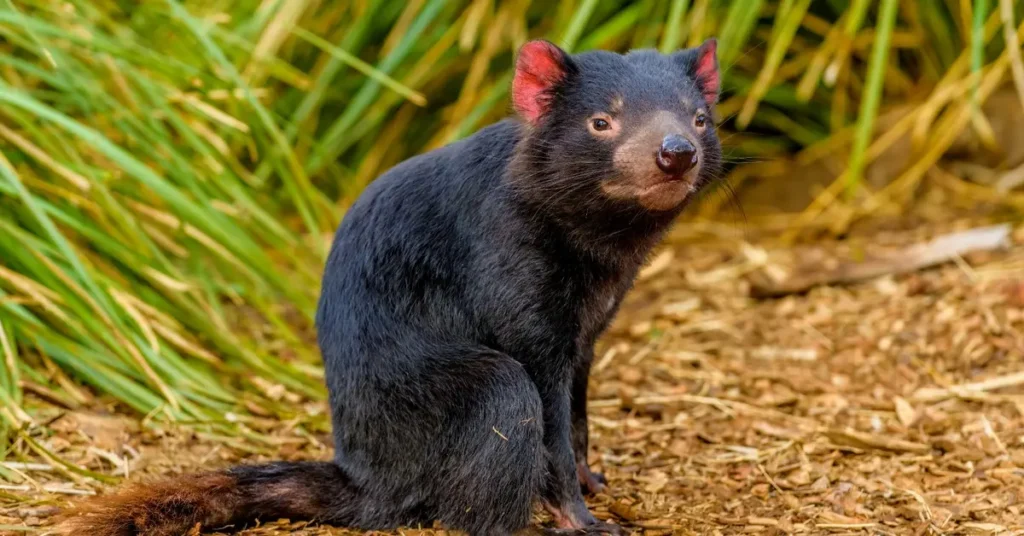
Thylacine de-extinction technology developed by Colossal Biosciences is now being redirected to protect a living marsupial, as the same reproductive and marsupial-science platforms built to revive the extinct Tasmanian tiger are applied to the fight to save the Tasmanian devil. Through its nonprofit arm, the Colossal Foundation, the Dallas-based company has announced a partnership with the University of Tasmania that turns tools originally created for de-extinction toward an endangered species still clinging to survival.
Thylacine de-extinction technology is being repurposed to protect a living species
The core of the announcement is a crossover: technologies Colossal Biosciences developed while working to bring back the thylacine are now being deployed against a devastating wildlife disease afflicting the Tasmanian devil. The marsupial husbandry, reproductive science, and de-extinction technologies refined for the extinct Tasmanian tiger are being turned toward a species that is still alive but under severe threat.
The disease at the center of the effort is devil facial tumour disease, a contagious cancer first identified in 1996. A second strain appeared in 2014, and together they have driven wild Tasmanian devil populations down by roughly 80 percent. Because the cancer spreads through biting — a natural part of how devils eat, mate, and interact — it has proven extremely difficult to stop through traditional conservation methods.
“This partnership reflects exactly why Colossal exists. Our de-extinction programs are fueling the development of entirely new biological tools and platforms.”
— Ben Lamm, Co-Founder and CEO, Colossal Biosciences
The research attacks the disease on two fronts
The University of Tasmania partnership tackles devil facial tumour disease through two parallel scientific approaches, combining vaccine development with genomic research into natural resistance. Both draw on the marsupial expertise Colossal built through its thylacine program.
- An oral vaccine: University of Tasmania immunologist Andrew Flies has spent years developing an oral vaccine designed to teach the devil’s immune system to identify and destroy tumor cells before they become established.
- A resistance gene: Researchers plan to investigate LZTR1, a gene linked to two unusual mutations found only in devils, to determine whether de-extinction technologies could make the animals more naturally resistant to the cancer.
The fat-tailed dunnart serves as a safe stand-in for the endangered devil
Before any vaccine or genomic intervention can be tested in an endangered Tasmanian devil, researchers need a safe surrogate — and the mouse-sized fat-tailed dunnart fills that role. As a close evolutionary relative of the devil, the dunnart allows treatments to be validated in a non-endangered model first, reducing risk to the vulnerable target species.
The Colossal Foundation is helping the University of Tasmania establish a dedicated dunnart colony in Hobart, using breeding and husbandry methods originally developed for Colossal’s work toward reviving the thylacine. That same thylacine research had already helped establish the dunnart as a powerful model for marsupial genomics and reproductive science — meaning the de-extinction effort produced a conservation tool before the disease work even began.
Colossal frames the effort as proof of de-extinction’s conservation value
For Colossal Biosciences, the partnership demonstrates a central argument the company has long made: that the technologies developed in pursuit of de-extinction generate broadly useful biological tools for living species. Executive Director of the Colossal Foundation Matt James described devil facial tumour disease as one of the most devastating wildlife diseases on Earth, a contagious cancer pushing an iconic marsupial toward collapse with consequences for the ecology of an entire island.
James credited Andrew Flies and his University of Tasmania team with building the most advanced disease-vaccine pipeline in existence, and said combining that work with Colossal’s marsupial husbandry, reproductive science, and de-extinction technologies creates a real opportunity to accelerate the effort and give the Tasmanian devil a fighting chance.
Conservationists on the ground see a rare path forward
For those who have watched the disease spread across Tasmania for decades, the collaboration carries personal stakes. Greg Irons, Director of Bonorong Wildlife Sanctuary, has cared for hundreds of devils across the nearly thirty years the disease has ravaged the island’s population.
“For nearly thirty years, we have watched DFTD mercilessly take countless devils from the Tasmanian landscape. Anything that gives our devils a real path back deserves our full support.”
— Greg Irons, Director, Bonorong Wildlife Sanctuary
With the collaboration now underway, researchers hope the combination of vaccine development, genomic research, and a tiny marsupial stand-in can finally give the Tasmanian devil a better chance at survival — powered by the same conservation tools first built to revive a species that vanished decades ago.
This story is based on original reporting by Reese Watson for Distractify. Read the full feature on Distractify →